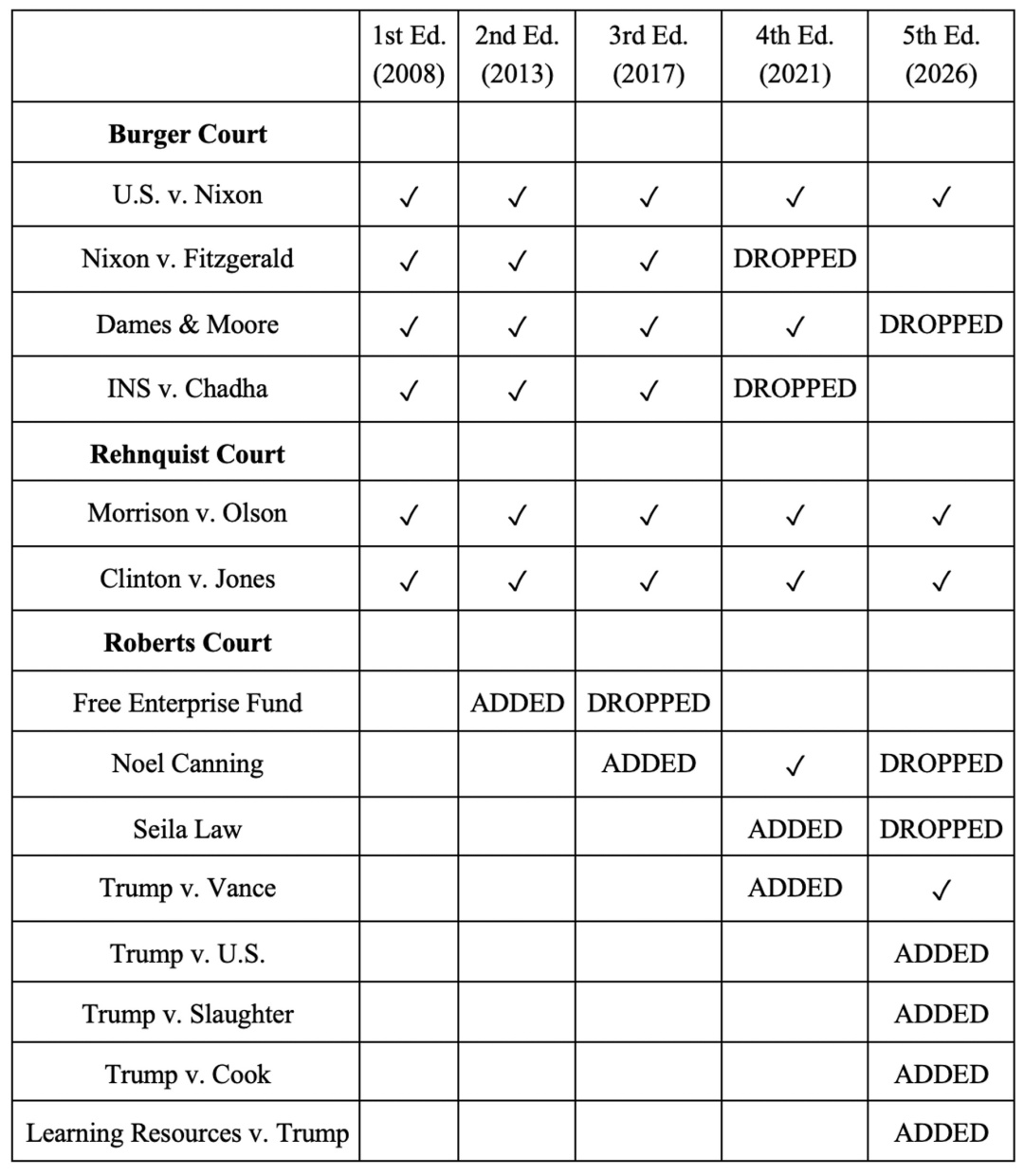
Congress and the President: A Tug-of-War with All the Rules for Tugging Thrown Out
In what can only be described as a legal circus, the separation of powers between Congress and the President has become an acrobatic performance where both parties exhibit remarkable flexibility. With the latest SCOTUSBlog installment, we learn that while Congress still exists theoretically, its power seems to be an excellent candidate for the next great disappearing act.
The late 1990s heralded the Rehnquist federalism revolution, a time when Congress was reminded that its powers might not be as expansive as it once thought. Fast forward to the aftermath of 9/11, and suddenly we see the President donning a superhero cape, claiming powers that seem to grow every time Congress attempts to assert itself. Yet, here we are in 2023, and if Congress had a dollar for every time it felt overshadowed, well, it could probably fund a very nice retreat for lawmakers to reconsider their lives.
Still Beats Watergate:
Sponsor success. Continue reading:
The narrative from the early 2000s is a deliciously ironic one. The powers of the president ballooned while Congress opted for a more laid-back approach, sitting back and watching as the executive branch threw a lavish party with constitutional authority. Meanwhile, Congress appears to have mislaid the invite to the festivities, or perhaps it was simply lost in the mail—a common occurrence in Washington, where nothing is ever truly lost, just conveniently out of sight.
As we continue to witness this peculiar dance, professors are left scratching their heads and students are desperately seeking answers. The struggle to teach constitutional law has morphed into an exercise in frustration akin to explaining quantum physics to a goldfish. Perhaps it’s time for legal educators to abandon their traditional textbooks and start handing out survival kits instead.
The Erosion of Legal Precedents
This installment of SCOTUSBlog paints a picture of a legal framework so malleable that it might as well be made of Play-Doh. As the Roberts court continues to chip away at precedents with all the grace of a toddler in a pottery class, one can't help but wonder what the long-term implications will be for democracy itself. Maybe the real separation of powers lies not in the legal doctrines but in the increasingly performative tactics that have reduced serious governance to a series of political stunts.
In the end, we might be left asking ourselves: is the separation of powers a principle worth fighting for, or just another concept to be interpreted in whatever way suits the occasion? Either way, it appears that Congress and the President will continue their comedic duet for years to come, with neither wanting to take ownership of the mess created by the other.
Your Takeaway
As the narrative evolves, we can only watch with bated breath—and perhaps a glass of wine—as Congress and the President navigate this theatrical tug-of-war. This is not merely a constitutional debate; it’s a reality show in which the stakes are nothing less than the future of governance. With each act, we’re reminded that in this grand performance, the audience, aka the American public, is left to ponder just how much longer the show can go on without a significant plot twist.
In conclusion, the separation of powers, while still in theory very much alive, has devolved into a spectacle of bureaucratic gymnastics. Whether this is a triumph of modern governance or simply a farce remains to be seen. As we hold our breath for the next episode in this riveting saga, one thing is certain: we’ll be watching—coffee in hand, ready for whatever absurdity they throw our way next.