China’s Vice President Unveils His Favorite Talking Points at the U.N.
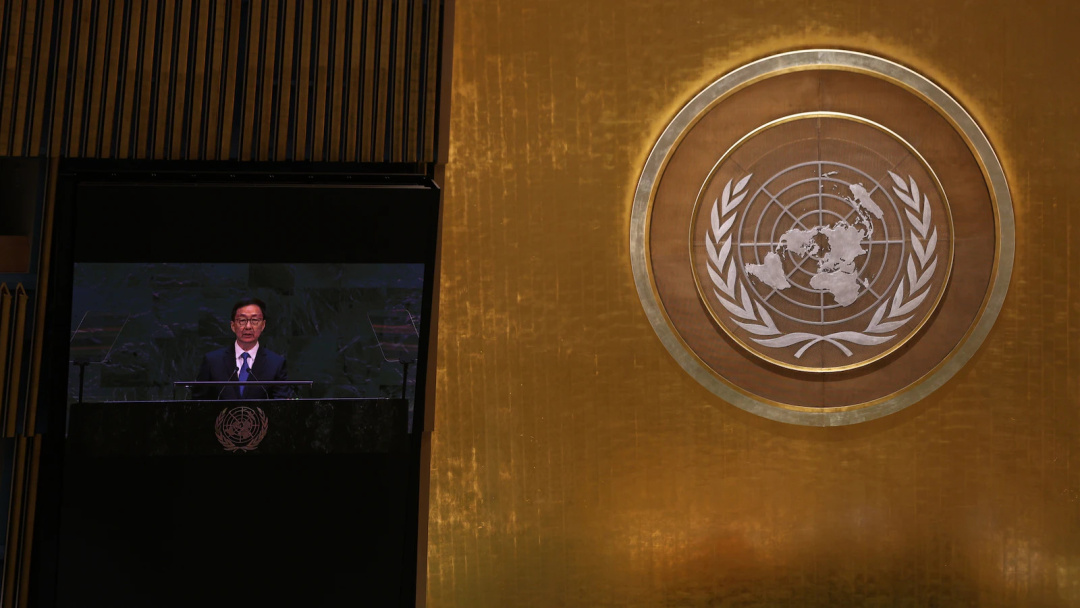
In a performance that could only be described as a diplomatic rerun, China's Vice President Han Zheng delivered his latest monologue at the United Nations, touting the usual script of global development solutions while artfully sidestepping anything too spicy. One might say he played it safe, taking the podium just a day after a high-profile dinner with President Trump—a moment that left many wondering if the vice president had left his A-game at the table.
"China has created two miracles at home, namely fast economic roles and long-term social stability," Han proclaimed, as if reciting from a well-worn script. It’s worth noting that as he preached about development, Taiwan was conspicuously absent from his talking points, perhaps a strategic move to keep things cordial with Washington amid ongoing tensions. After all, why poke the bear when you’re trying to negotiate a dinner invitation?
Still Beats Watergate:
Sponsor success. Continue reading:
Han’s speech, which bore a striking resemblance to past addresses from Chinese officials, focused heavily on the theme of development, positioning it as the heart and soul of global progress. He stated, "Protectionism produces no winners," a veiled reference to the trade tensions simmering between the U.S. and China, but one that did little to spark any real debate. Instead, it served as a reminder that while countries squabble over tariffs, China is eager to remind everyone of its role as the benevolent giant, ready to lead the world into a new era of cooperation—at least until the next round of tariffs.
The absence of any direct confrontation regarding Taiwan was particularly noteworthy, echoing a strategy that seems to say, "Let’s not rock the boat too much, especially not in front of the international audience." This tactic of omission could be seen as an attempt to maintain a façade of diplomacy, while quietly reinforcing its claims over the self-governing island behind closed doors.
Yet, Han’s insistence on multilateralism as a cornerstone for international relations, presented with all the fervor of a seasoned politician, might evoke a chuckle from those familiar with China’s own approach to global governance. "We should settle differences through dialogue and consultation," he declared, adding a sprinkle of irony considering China’s historical reluctance to embrace such practices when it suits its narrative. This has led to observers questioning whether this speech was more about optics than substance, a common critique of international diplomacy that often feels like a performance art piece with little tangible outcome.
As Han wrapped up his soliloquy, he emphasized a commitment to the Global South, a phrase that is increasingly gaining traction but often raises eyebrows regarding intentions. Notably, he proclaimed that China has engaged with three-quarters of the countries participating in the Belt and Road Initiative, a project many criticize as a vehicle for expanding Chinese influence rather than genuine development.
China's Diplomatic Dance Continues
Reflecting on Xi Jinping’s conspicuous absence from the U.N. podium, many pundits speculated whether it signaled a shift in China’s diplomatic strategy. But it’s essential to remember that previous Chinese leaders haven’t always made the U.N. their priority, choosing instead to engage in a more selective approach. The absence of the top leader likely wasn’t an omen but rather a calculated decision to allow his deputy to assume the stage, demonstrating a layered approach to international relations.
The implications of Han's speech extend beyond mere rhetoric; it serves as a reminder that China is keen to assert itself as a leader on the global stage while managing its relationships delicately, especially with the U.S. As the world watches, one must wonder how this performance will play out in the ever-complex interplay of global politics.
Your takeaway
In this age of constant scrutiny and diplomatic theater, Han's speech exemplifies the art of spin that defines modern international relations. While the talking points may reflect a commitment to development, the true narrative, often obscured by polished oratory, reveals a nation that is still seeking to navigate its ambitions amid growing scrutiny from the West. The stage is set; the question remains—will the audience be convinced, or will they see through the familiar script?