Wike Enforces Political Fealty Post-Election with Instructions to Adeleke
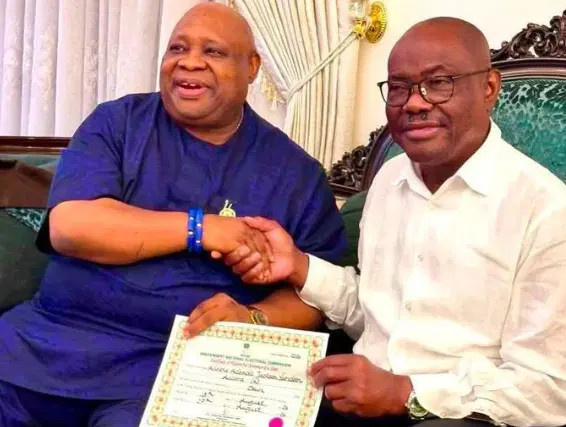
Wike enforces political fealty post-election with instructions to Adeleke. In a striking display of political theatrics, Nigerian Minister Nyesom Wike has reportedly taken it upon himself to ensure that re-elected Osun State Governor Ademola Adeleke publicly kisses the ring of President Bola Tinubu. Following Adeleke’s victory on August 15, Wike disclosed that he personally instructed the governor to reaffirm his loyalty to Tinubu, a move that raises eyebrows about who really holds the reins of power in Nigeria.
During a recent media parley in Port Harcourt, Wike recounted his concern: if Adeleke wins, would he still support Mr. President? This question, posed with all the gravitas of a political soap opera, underscores the absurdity of party loyalty being dictated from on high, rather than organically arising from the electorate’s choices at the polls. Wike's follow-up call to Adeleke, while vacationing in Croatia no less, to remind him to issue a statement thanking Tinubu for a "free and fair election" adds another layer of theatrical absurdity to this political drama.
Still Beats Watergate:
Sponsor success. Continue reading:
The directive culminated in Adeleke's ceremonial presentation of his Certificate of Return to the President, a moment seemingly choreographed to avoid any unwanted political fallout from the African Democratic Congress, ADC. Wike candidly described this maneuver as a strategic necessity, highlighting how political actors can reshape narratives post-election, effectively usurping the voter mandate in favor of backroom negotiations. The implication is that once the votes are counted, the real game begins behind closed doors—a scenario that could make Machiavelli nod in approval.
Political analysts, like Prof. Anthony Kila, express concerns that this method of governance risks personalization over policy, suggesting that Nigerian democracy may be morphing into a system where political allegiances can be negotiated like commodities. The danger lies in the growing perception that without aligning with the ruling party, elected officials might face harsher realities, thus questioning the integrity of the democratic process itself. The idea that a governor must reassure a president of his loyalty post-election is a deeply troubling optic for democracy.
The Dilemma of Political Mandates
As reactions on social media continue to swirl, a troubling question arises: how much of a mandate remains when political leaders feel compelled to negotiate their allegiance to the ruling party after voters have cast their ballots? Concerns grow over the implications of such backdoor dealings, especially given the prevailing distrust of electoral institutions in Nigeria. Many see these developments as a stark reminder that while votes may be cast in public, the power dynamics that shape political reality often unfold in private.
Amid the chaos, the Wike-Adeleke saga lays bare the vulnerabilities within Nigeria’s political landscape. It poses a critical inquiry into the actual strength of democracy in a nation where political survival may hinge on personal loyalty more than public mandate.
Your Takeaway
As the dust settles on this political drama, it becomes increasingly clear that the negotiation between power players after an election may undermine public confidence in the electoral process itself. The potential for such negotiations to exist corrupts the very foundation of democracy—where the people, not political insiders, should dictate the course of governance. Wike's brazen intervention may be a mere political maneuver, but it echoes a warning: the perceived necessity of such loyalty tests to preserve power is indicative of a deeper systemic flaw.
Ultimately, the spectacle of Wike instructing Adeleke serves as a poignant reminder of the precarious balance between power, loyalty, and democratic integrity. If the future of Nigeria's democracy is to be determined not just at the ballot box but through backroom bargains, then citizens must ask who truly holds the power—the voter or the political negotiator cloistered away from the public eye?