Trump's Guide to Winning Friends and Influencing Enemies
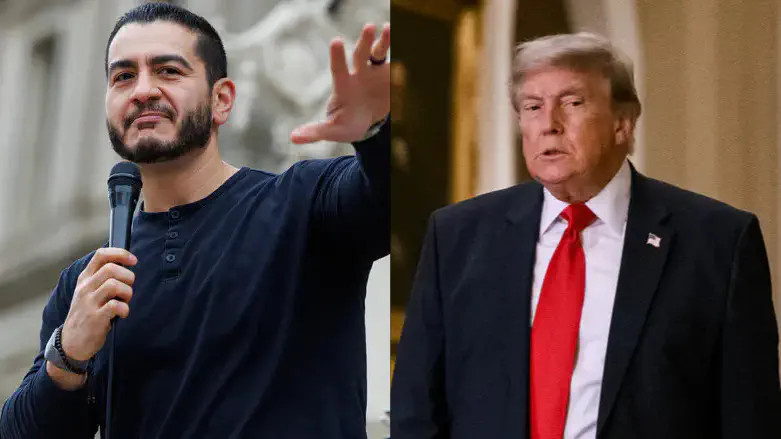
In a recent episode of Trump’s ongoing series "How to Alienate Potential Allies in Five Easy Steps," the former president took a detour to Michigan, where he launched a spirited critique of Democratic primary winner Abdul El-Sayed. Labeling El-Sayed a ‘communist’ and a ‘man of hate’—two titles that seem to be the only labels Trump can remember—he proved once again that diplomacy is overrated when you can just hurl insults like confetti at a parade.
Trump, speaking from the sun-kissed battleground of Nevada, asserted that El-Sayed was ‘full of s--t,’ a claim that, while lacking in specificity, was delivered with trademark gusto. The former president's strategy appears to hinge on the notion that if you say something loud enough, it must be true, a principle that has worked wonders in his own electoral playbook.
Still Beats Watergate:
Sponsor success. Continue reading:
In a rhetorical flourish that could only be described as a high-speed chase through the land of hyperbole, Trump elaborated on his disdain for the Michigan candidate. ‘This guy hates Jews,’ he proclaimed, as though unveiling a hidden truth. The statement, which seemed more like a desperate ploy to rally his base than a reasoned critique, quickly drew attention to the administration’s questionable grasp of both facts and decency.
What Trump failed to mention, however, is that El-Sayed’s victory posed a significant threat to the traditional power dynamics within the Democratic Party. The establishment's pro-Israel faction, represented by the now-defeated Haley Stevens, was left reeling, as if they had just found out their favorite sitcom was canceled. In a landscape where political endorsements from figures like Bernie Sanders and Alexandria Ocasio-Cortez are akin to receiving a golden ticket, El-Sayed’s rise signifies a shift towards a more progressive agenda that makes establishment figures shudder.
As Trump confidently suggested that the Republican nominee Mike Rogers would easily trounce El-Sayed in the upcoming Senate contest, one couldn't help but wonder if he was actually channeling the spirit of optimism or if he was simply high on the fumes of his own hyperbole. His mantra that Republicans fare better against ‘communists’ seemed less like a political strategy and more like a panic button for a party struggling to retain relevance in an ever-evolving political landscape.
El-Sayed’s campaign, which openly criticized U.S. military assistance for Israel and condemned Israeli actions in Gaza, is a reminder that the political battlefield is far from static. With demographics shifting and voter attitudes changing, the notion that Trump’s bravado will guarantee victory against a candidate with such a strong grassroots following may be wishful thinking.
In the end, while Trump’s rhetoric might have resonated with a certain segment of his base, it also underscores a deeper contradiction within the Republican Party: how to engage with an increasingly diverse electorate without alienating the very voters they hope to attract. As the political drama unfolds, one thing is certain—the only thing more unpredictable than Trump's speeches is how his party will navigate the turbulence they create.
As we look ahead to the general election, it seems Trump's strategy of name-calling may not be the silver bullet he believes it to be. With El-Sayed at the forefront, the Democratic Party might just find itself more united than ever, as they rally against the ‘man of hate’ who can’t seem to keep his foot out of his mouth. While Trump may be serving up a smorgasbord of insults, the real question remains: can he deliver a winning platter come election season?