Trump Unveils Revolutionary Election Security Strategy: Denial and Distrust
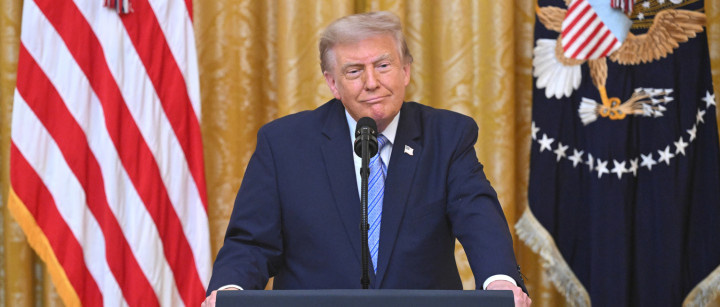
In an unprecedented display of electoral acumen, former President Trump recently unveiled what he calls a revolutionary election security strategy. This bold initiative, which aims to protect American democracy, rests on a foundation of denial and distrust—perfect for an age where facts are mere suggestions and skepticism reigns supreme. The strategy is simple: if you can’t prove the election was stolen, just keep saying it was until everyone believes it.
Trump's keynote speech, delivered with all the gravitas of a late-night infomercial, warned of alarming vulnerabilities in the election infrastructure. He painted a picture so dire that it could only be compared to the plot of a low-budget horror film—a narrative where shadows lurk around every polling station, and every ballot cast is another step toward a dystopian nightmare. Yet, in classic Trump fashion, he provided no evidence to back up his claims, relying instead on the power of repetition to instill fear and uncertainty in the hearts of his followers.
Still Beats Watergate:
Sponsor success. Continue reading:
The former president referenced a trove of documents that supposedly revealed a sinister plot by foreign powers to compromise U.S. election data. However, experts quickly pointed out that the information was as groundbreaking as a five-year-old report on the dangers of forgetting your umbrella during a rainstorm. According to David Becker, executive director of the Center for Election Innovation & Research, there was nothing new or alarming in Trump's revelations. Instead, it was a classic case of repackaging old news to elicit a fresh wave of panic among the uninitiated.
In a particularly striking moment, Trump claimed that China had conducted the largest compromise of election data in history, acquiring 220 million U.S. voter files. But election experts were quick to clarify that these files are largely public and often sold like hotcakes on the open market—hardly the nefarious scheme Trump painted it to be. It turns out that the only thing compromised was his understanding of basic data accessibility.
As the speech progressed, Trump’s rhetoric escalated from fear-mongering to outright absurdity, suggesting that the mere existence of publicly available data was evidence of a catastrophic breach. The irony was thick enough to cut with a knife, as he invoked the ghost of foreign interference with all the seriousness of a game show host revealing the next contestant.
Even more comical was Trump's insistence that the documents he was declassifying would protect against foreign meddling in future elections. This was like announcing an exciting new line of defensive strategies while simultaneously leaving the back door wide open. The underlying message was clear: if we can’t secure the truth, let’s at least secure the narrative.
And what about the alleged 278,000 noncitizens registered to vote? Trump touted this figure with the enthusiasm of a child showing off his crayon drawings, yet the methodology behind this claim was as murky as a swamp at midnight. The Department of Homeland Security's review was criticized for lacking transparency, and many states quickly dismissed the numbers as wildly speculative.
In a stunning act of defiance against common sense, Trump concluded his address with a pledge to ensure that America would "never watch a stolen election again." The irony was palpable: a man who has spent years alleging widespread fraud without a shred of proof was now positioning himself as the defender of electoral integrity.
As the political theater unfolds, one thing is clear: in Trump's world, the truth may be negotiable, but the performance must go on. With each speech, he not only rewrites the rules of engagement but also redefines the very essence of democracy itself. Welcome to the new age of political debate, where facts are optional, and suspicion is the currency of choice.