Eisenkot Given First Shot at Leading a Collab of Unlikely Allies—Good Luck with That!
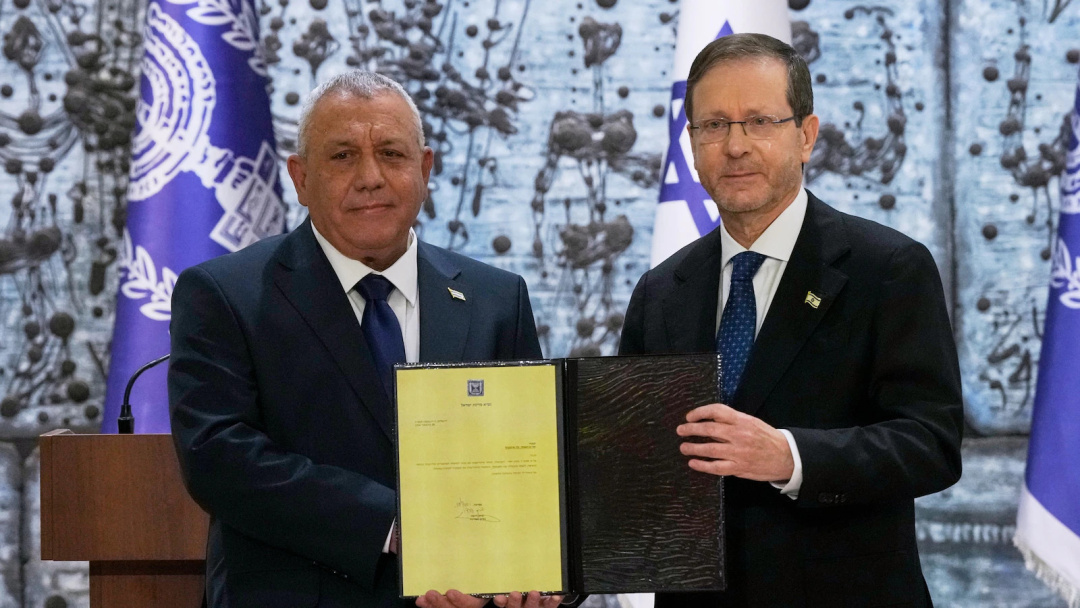
Israeli President Isaac Herzog, in what can only be described as a bold gamble, has officially designated Gadi Eisenkot as the first contender to form the next government. This announcement came amidst a political landscape that resembles a chaotic game of Jenga played by a group of toddlers after too much sugar.
Eisenkot, a former military chief, is now tasked with navigating the treacherous waters of coalition-building in a divided Knesset, where the opposition he leads has more factions than a high school drama club. His goal? To unite a country still reeling from the fallout of the recent Hamas-led attacks and the ensuing wars, which have left more scars than a bad tattoo.
Still Beats Watergate:
Sponsor success. Continue reading:
"I genuinely hope that whoever ends up forming a government can achieve unity and healing among our people," Herzog said, possibly while crossing his fingers behind his back. The reality, however, is that the odds are stacked against Eisenkot, who has a mere six weeks to gather enough support to proclaim victory.
As the clock ticks, his coalition options look as appetizing as a plate of day-old gefilte fish. The Arab-led parties, having recently made historic gains, are eyeing Eisenkot like kids at a birthday party, eager to help but wary of the cake's ingredients. The Joint List has offered support, but this cooperation feels about as stable as a sandcastle at high tide.
Eisenkot has laid out his conditions for those who wish to join his coalition: they must acknowledge Israel as a Jewish and democratic state—a reasonable request unless you’re trying to build a government with those who see it as a historical fiction. Meanwhile, Netanyahu, ever the ringmaster in this circus, has labeled any collaboration with Arab parties as a betrayal, because nothing says national unity like name-calling and paranoia.
Navigating Coalition Challenges and External Pressures
Moreover, the investigation into alleged foreign interference in the recent elections adds another layer of confusion to an already muddled picture. It's like adding hot sauce to a dish that was already way too spicy. Both Herzog and Eisenkot have remarked on the challenges ahead, aligning national issues with the more immediate concern of how to make it out of coalition talks alive.
As if that wasn’t enough, Eisenkot must also appease the ultra-Orthodox parties, who are clinging to their military exemptions like a life raft. With the public clamoring for equal service, the ultra-Orthodox are as eager to relinquish their privileges as a cat is to take a bath.
The political tension in Israel is palpable, with Netanyahu’s caretaker cabinet watching from the sidelines like hawks, ready to swoop in if Eisenkot falters. The possibility of returning to elections hangs over everyone like a cloud of impending doom, further complicating the negotiations.
Your takeaway
In the face of these challenges, it seems that Eisenkot’s success will depend on a mix of skillful maneuvering, a dash of luck, and perhaps a prayer or two. With the Knesset swearing in its new members soon, the clock is ticking, and the stakes couldn’t be higher.
For Eisenkot, it’s not just about forming a government; it’s about steering a ship through turbulent waters while dodging icebergs, all while the public watches and waits, popcorn in hand. Will he succeed, or will the whole endeavor sink faster than a lead balloon? Stay tuned as this saga continues to unfold!